Pick something with a melody, not a beep. A small study found that people who called their waking sound melodic were more likely to report no grogginess. The result is modest. My opinion goes further: the default beep is the worst choice on your phone.
The study in numbers
The paper most people cite is by Stuart McFarlane and colleagues at RMIT University, published in PLOS ONE in 2020. It asked people about their waking sound and about sleep inertia, the groggy, slow stretch after waking.
What it found, and what it did not
People who rated their waking sound as melodic were more likely to report no sleep inertia.
The type of sound, such as music versus a tone, showed no significant link. Neither did how people felt about their sound.
Grogginess was self-reported, up to four hours after waking. The melody result came from a post hoc analysis, and the authors call the findings preliminary.
Birdsong alarms. The authors mention dawn birdsong only as a possible example, and say plainly they did not test it.
That is a hint, not a settled fact. I found no research that tested birdsong alarms, so nobody should tell you birdsong is proven to help.
Why I still think melody wins
Studies aside, here is my reasoning, labelled as opinion.
A beep is built to be unpleasant. Its job is to be hard to ignore. I think that is a bad trade at 6:30 in the morning: you start the day irritated at your own phone, then hit snooze to make it stop.
A melody gives you something to follow. The RMIT result, thin as it is, points the same direction. You do not have to believe it changes how you feel. It is enough that it is a more pleasant noise.
A slow start helps. A sound at full volume from the first second is a shock. One that builds gives you a moment to come up to it.
| Beep | Melody that builds | |
|---|---|---|
| Job | Be hard to ignore | Be followed |
| First second | Full strength | Quiet |
| My verdict | Worst option | What I would pick |
Choose your sound in five steps
- Think long termPick a sound you would not mind hearing every day. A favourite song may be worn out in two weeks.
- Find a clear tuneChoose something you could hum.
- Test itSet an alarm one minute ahead and listen.
- Check that it wakes youA gentle alarm that fails is worse than a harsh one that works.
- Protect your sleepNo sound makes up for too little of it.
Where Wakebird fits
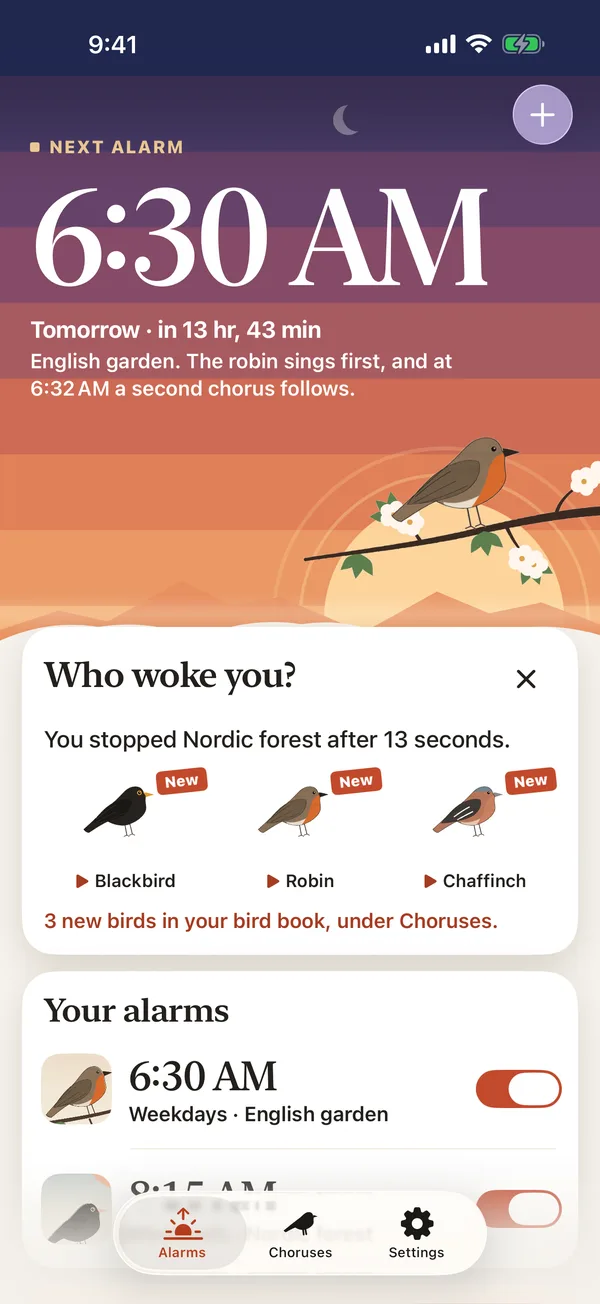
I am the developer of Wakebird, so weigh my view accordingly. It rings with real birdsong: one bird starts softly, and others join over 29 seconds. If you sleep on, a second chorus starts two minutes later, and it shows which birds woke you.
 See Wakebird on the App Store
It uses iOS's own alarm system, so it rings on silent or in a Focus. It is a one-time purchase with no subscription. I have not shown that it helps you wake better. I just think it is a nicer way to be woken.